
Good attic ventilation helps your roof last. It lets heat and moisture escape, which keeps shingles from baking from below in summer and limits condensation in winter. Family Tree Roofing checks ventilation on every inspection, calculates it on every roofing estimate and recommends corrections where the attic needs them.
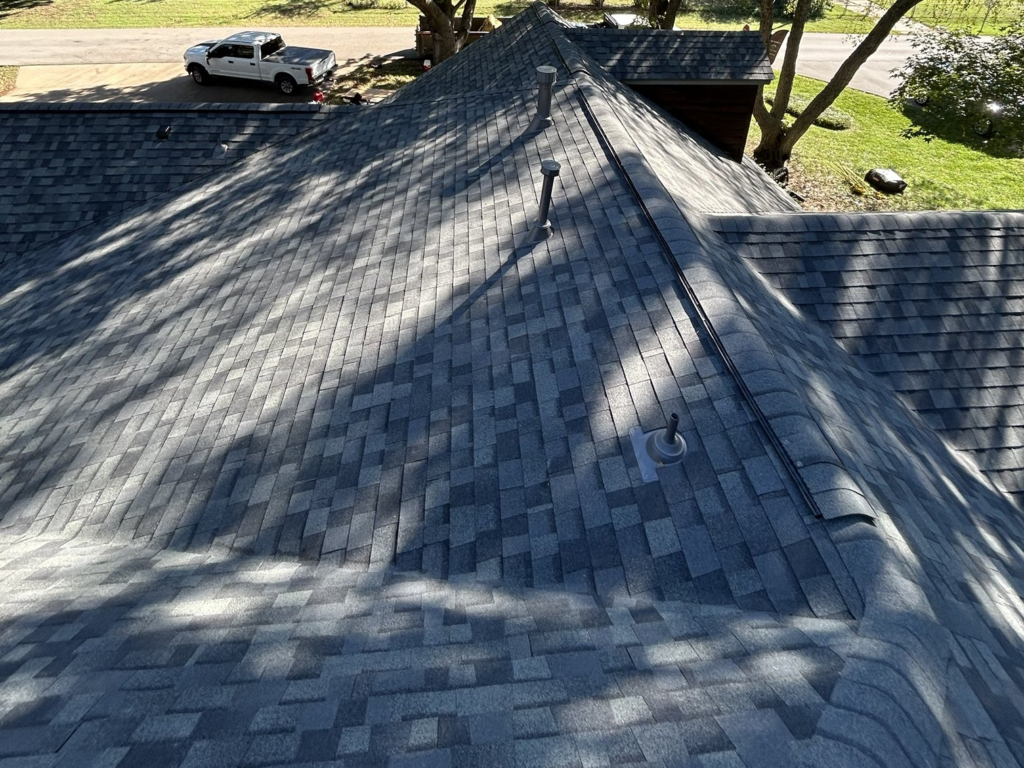
Signs of poor attic ventilation
- An attic that feels extremely hot in summer.
- Frost, condensation or damp insulation in the attic in cold weather.
- Shingles that curl, blister or age faster than expected.
- Musty smells or signs of mold on the underside of the roof deck.
- Ice buildup along the eaves during winter storms.
How attic ventilation works
A balanced system pulls cooler outside air in low, usually through soffit vents, and lets warm, moist air out high, through ridge vents or other exhaust vents. When intake is blocked by insulation or there is too little exhaust, heat and moisture build up. Mixing different exhaust types on the same roof can also short-circuit the airflow.
What we do
- Check intake and exhaust vents and look for blocked soffits.
- Look for signs of moisture or heat damage in the attic.
- Calculate the ventilation your attic needs and show you the numbers, not a guess.
- Recommend improvements where they are warranted, price them, and explain what difference they make.
- Install or correct ventilation as part of a repair or replacement, following the shingle manufacturer’s requirements.
Hot attic or early shingle wear? Start with a free inspection.
Tell us what is going on and we will set a time that works for you. No pressure, no obligation — just clear answers from a local, family-owned team.
Related: roof replacement or free roof inspection.
We calculate ventilation on every estimate
Ventilation is not an upsell we remember at the end. We work out the requirement on every roofing estimate, show you what we found, recommend improvements where they are needed and give you the pricing with everything else.
Every house is different, so we look at intake and exhaust together and design around the shape of the roof and whatever is already up there. Ridge vents, box vents, soffit intake and powered or solar equipment all have a place, and none of them is automatically the answer. A roof with very little ridge length, for example, is usually a poor candidate for a ridge-vent-only design. Powered and solar fans in particular need enough intake behind them, or they can pull conditioned air out of the house instead of air out of the attic, so we check that before recommending one. We use ventilation calculation tools rather than rules of thumb.
What we find in Tulsa-area attics
- Attics that get extremely hot through an Oklahoma summer.
- Moisture building up through the winter.
- Mold or microbial growth concerns that come along with that moisture. We are roofers, not mold inspectors, so we will tell you what we see and when it is worth having someone qualified look at it.
- Rusted roofing nails and other signs of condensation on the underside of the deck.
- Roofing systems wearing out early in houses where attic conditions were never managed.
Ventilation is not the only thing that decides how long a roof lasts, and no honest number exists for exactly how much of the difference it makes. What is well established is the relationship: attic temperature and moisture affect how shingles age and how the structure beneath them holds up, and shingle manufacturers set ventilation requirements that their warranties depend on. That is reason enough for us to measure it properly on every job.
Ventilation questions
Can ventilation be fixed without a new roof?
Often, yes. Clearing or adding intake, or changing the exhaust, can sometimes be done on its own. What makes sense depends on the shape of the roof and what is already up there, and we will tell you what fits yours.
Does ventilation affect my shingle warranty?
It can. Shingle manufacturers set ventilation requirements, so we make sure ventilation meets them when we install a new roof.
Should I add a powered or solar attic fan?
Not by default. A powered or solar fan can be the right choice on some roofs, but only with enough intake behind it; without that it can pull conditioned air out of the house. We look at intake and exhaust together before recommending any fan.